Album Review: Rob Zombie – The Great Satan
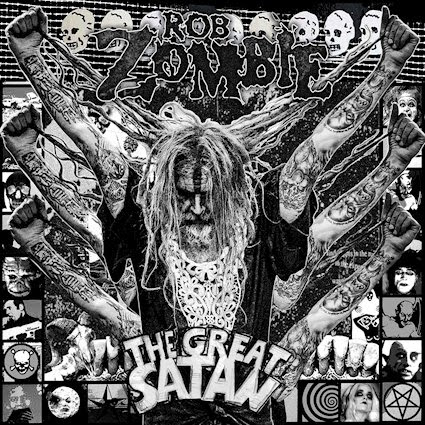
Shock rock has always thrived on excess, but longevity in the format also requires control and a dedication, to the fans and yourself. That balance sits at the core of Rob Zombie’s eighth solo album, The Great Satan, a record that trims the indulgence of his recent work in favor of sharper riffs, faster overall pacing and a rediscovered sense of artistic direction.
Released through Nuclear Blast, the 15-track album arrives as a deliberate course correction following the sprawling experimentation of The Lunar Injection Kool Aid Eclipse Conspiracy. Where that record drifted into a psychedelic collage, The Great Satan feels like it’s built to move with its shorter songs, tighter structures and a deliberate emphasis on band chemistry over intricate studio layering and arrangements.
The opening burst of “F.T.W. 84,” leans fully into that shift, dropping straight into the familiar distortion and a metal groove that echoes the snap of Zombie’s earlier efforts. The song wastes little time establishing the albums pace, favoring immediacy over buildup as ideas arrive quickly and move on. Even the more offbeat touches stay grounded in tight arrangements and the favored riff forward writing, reinforcing the album’s emphasis on motion and cohesion rather than another layered spectacle.
“Tarantula” and “(I’m a) Rock ’N’ Roller,” keep all that warm fuzziness intact. The latter, one of the album’s early preview tracks, distills Zombie’s long-running fascination with rock mythology into something blunt and chant-ready. It’s knowingly over the top, but the simplicity is the strength. Zombie isn’t chasing reinvention here — he’s refining impact.
That direction comes to the forefront with “Punks and Demons,” the album’s defining single. Built on those beautiful thrashy guitars and a repetitive vocal hook, the track channels the immediacy that made Hellbilly Deluxe such a breakthrough without feeling like an imitation. The production is cleaner, the pacing tighter and the intent more focused. It plays less like nostalgia and more like an artist reconnecting with instinct.
“Heathen Days,” provides the first real shift in in the albums texture. Mechanical synth accents and sliding guitar lines give the song a frantic energy that highlights one of Zombie’s most reliable strengths, turning simple riffs into cinematic moments. It isn’t the heaviest cut on the record by any stretch but it’s among the most dynamic.
The album’s middle carries much of its different personality. Titles like “Black Rat Coffin” and “Sir Lord Acid Wolfman,” lean fully into the B-movie absurdity that has always fueled Zombie’s writing, yet musically they remain grounded following the direction of the earlier cuts. Heavy grooves and staggering tempo changes keep songs moving, preventing the theatrical elements from overwhelming the minimalist material.
“The Devilman” and “Out of Sight,” lean closest to traditional metal territory, built on chugging guitars and straightforward hooks designed for live translation. Meanwhile, “Welcome to the Electric Age,” injects sleazy futurism, layering synth textures over a stomp that feels engineered for festival stages and massive arena lighting cues.
What separates The Great Satan from some of Zombie’s recent releases is its overall discipline and the staying in your lane aspect of the album. Even when ideas verge on the edge of parody, the songs rarely overstay their welcome. The album runtime, just under 40 minutes, works brilliantly in the album’s favor, giving it a punchy and replayable quality that Zombies earlier projects sometimes lacked .
The closing run of “The Black Scorpion,” “Unclean Animals” and “Grave Discontent,” shifts the overall mood rather than chasing a massive direction changing finale. Instead, Zombie leans into the overall atmosphere by keeping the guitars heavy, but loosening the pace allowing the record to end on a darker, more cohesive note. It’s less about the spectacle and more about tone, reinforcing the album’s theme of control.
Producer Zeuss plays a significant role in the familiarity of the work. The mix keeps guitars forward while electronics function as texture instead of distraction. Zombie’s vocals sit inside the chaos rather than floating above it, a subtle change that makes the songs feel more like band performances than assembled sound design. In the broader context of Zombie’s catalog, The Great Satan lands as a refinement record. It doesn’t attempt to redefine his sound, nor does it need to. Instead, it sharpens the elements that have sustained his career thus far, horror aesthetics, groove-driven heaviness and a commitment to entertainment over technical showmanship. That approach won’t win over listeners who have never connected with Zombie’s style. But for longtime fans, the album feels intentional in a way some recent releases did not. There’s a sense of direction, a recognition that impact often comes from subtraction rather than escalation.
The Great Satan ultimately succeeds because it understands its purpose. It’s loud, fast and unapologetically strange, but it’s also efficient, a well designed sprint rather than a sprawling haunted attraction. In an era where legacy artists often chase reinvention, Rob Zombie instead doubles down on identity, delivering one of his most consistent and focused records in years. 8.0/10
Tracklist:
01. F.T.W. 84
02. Tarantula
03. (I’m a) Rock “N” Roller
04. Heathen Days
05. Who Am I?
06. Black Rat Coffin
07. Sir Lord Acid Wolfman
08. Punks And Demons
09. The Devilman
10. Out Of Sight
11. Revolution Motherfuckers
12. Welcome To The Electric Age
13. The Black Scorpion
14. Unclean Animals
15. Grave Discontent