Damn Right, He’s Still Got the Blues: Buddy Guy at Meadow Brook Amphitheatre
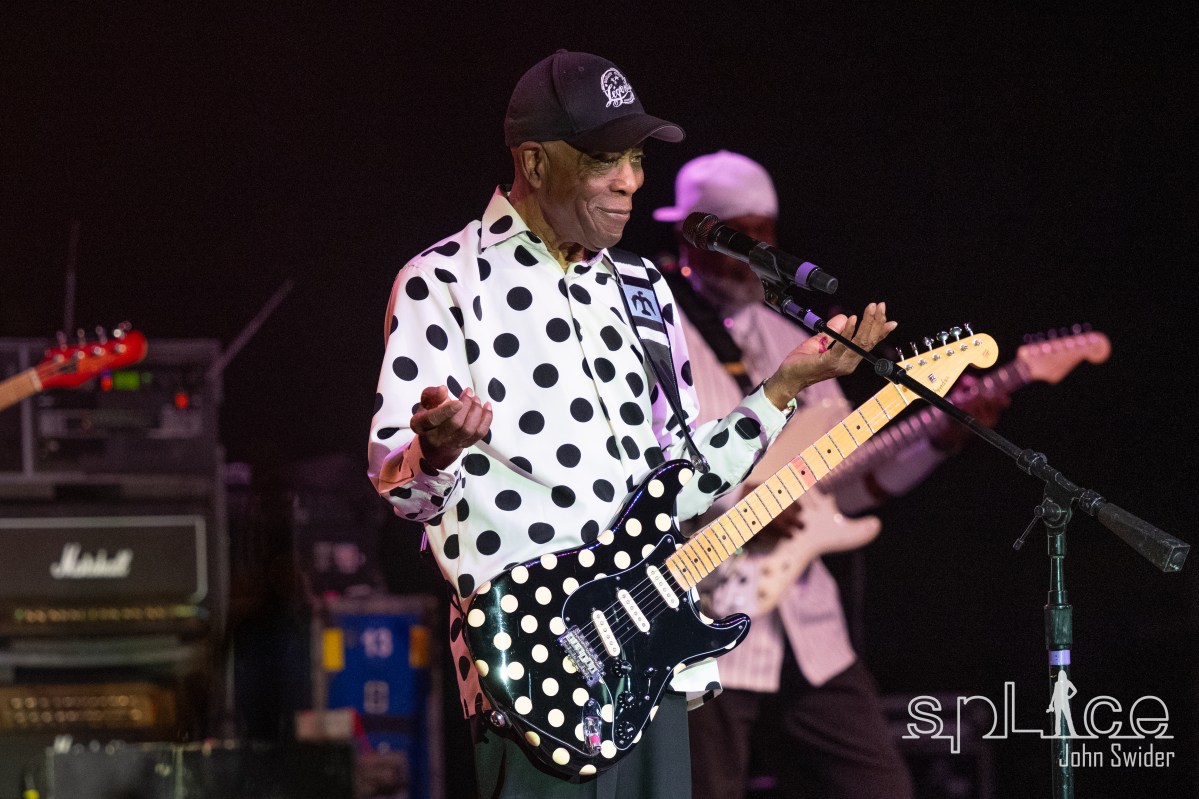
If the blues really are about telling the truth, Buddy Guy delivered it with a sledgehammer on July 19th at the Meadow Brook Amphitheatre in Rochester Hills. On a humid Michigan night beneath threatening sky’s, the 88-year-old blues legend—touring the country one last time on his aptly named “Damn Right Farewell” run—proved once again that age might take its toll on knees and backs, but not on soul. Not on tone—and definitely not on the wild, untamed spirit that’s driven his playing for more than six decades.
This wasn’t a show built on sentimentality or a soft landing into retirement. This was fire, grit, and charisma—all delivered by a man who plays like he has nothing left to prove, yet still approaches the stage like he’s got something to take.
Before Guy stepped into the spotlight, the evening opened with two young guitar slingers who made it abundantly clear that the future of the blues is in fierce, capable hands.
First up was Matthias Lattin, the Houston native and 2023 International Blues Challenge winner. At just 22, Lattin played with a poise and depth beyond his years. His tone was fat, his phrasing deliberate, and his stage presence understated but undeniable. He didn’t rely on flashy tricks or overbaked solos—instead, he let his guitar speak for him with soulful bends and tasty runs that landed with weight. Lattin showed the Meadow Brook crowd that the blues isn’t about playing fast—it’s about playing right. And that’s exactly what he did.
Next came Taj Farrant, the teenage phenom from Australia, whose presence onstage defied every expectation that comes with his age. Dressed in all black and a sweet Fedora, he stalked the front of the stage with swagger, laying into searing solos that recalled Stevie Ray Vaughan, Joe Bonamassa, and occasionally, even Buddy himself. His playing was aggressive but refined, and his tone—saturated and sweet—cut clean through the evening air. It wasn’t just technical prowess. Farrant played with the same feel every great blues axman has done, injecting every note with conviction. Watching him trade licks with his bandmates felt less like an opening act and more like a young wolf marking territory.
When the house lights finally dimmed around 9:35, Guy’s band walked out first, launching into a slow, simmering groove. Soon after,out came Buddy Guy—moving a little slower than he used to, maybe, but wearing that same devilish grin and the signature white shirt splashed in black polka dots. For a moment, Meadow Brook wasn’t just an amphitheatre—it was a church, and the congregation had just seen their preacher walk in.
Opening with “Damn Right, I’ve Got the Blues,” Guy came out swinging. No warm-up. No easing in. Just a sharp, stinging solo, full of tension and release, followed by that unmistakable growl of a voice—timeworn but still thunderous. It was immediately clear: this was not going to be the ceremonial victory lap that have became synonymous with end-of-runs. This was a full-on blues throwdown

The set that followed was a stunning blend of deep cuts, tributes, and Guy’s own warhorse tracks—each delivered with the conviction of a man who knows the history because he lived it. Willie Dixon’s “I’m Your Hoochie Coochie Man” got a filthy, raucous treatment, full of call-and-response antics with the crowd. “Fever” simmered in its restraint, with Guy milking every line for maximum tension. “Cheaper to Keep Her” had the audience howling in laughter and swaying with the groove.
Between songs, Guy was part frontman, part historian, and part stand-up comic. He cracked sly jokes about life, love, and aging. He poked fun at the crowd’s volume (“Y’all sound like you’re at church, not a damn blues show”), shared memories of his Louisiana upbringing, and told the now-famous story of the polka-dot Cadillac he once promised his mother. It’s not just stage banter with Buddy—it’s time travel. Every anecdote, every aside, every sideways smile feels like a direct transmission from a part of America that doesn’t show up in history books but left a permanent fingerprint on music.
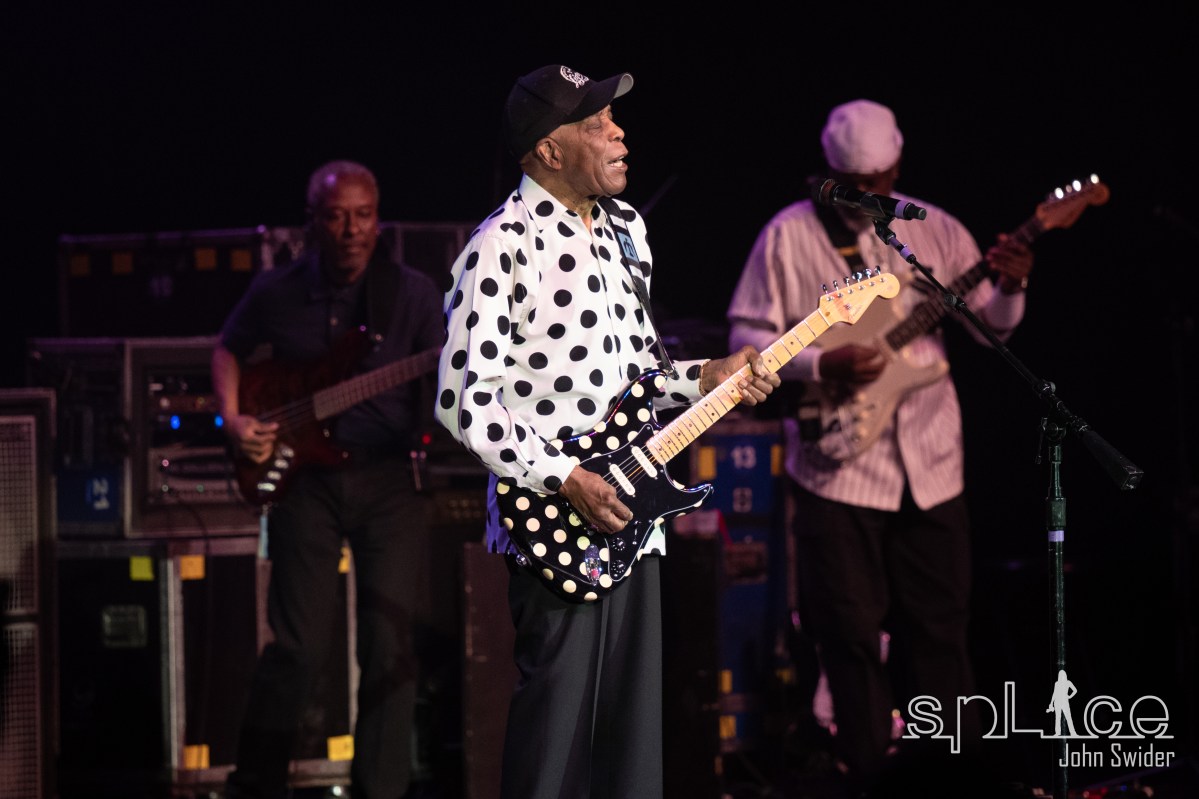
His band was every bit the well-oiled machine you’d expect from a blues institution. Dan Souvigney’s keyboards filled the edges with gospel and jazz flourishes, while bassist Orlando Wright kept everything anchored with his Chicago-honed low-end thump. Drummer Lenny White—a jazz fusion titan in his own right—brought surgical control and dynamic power. And guitarist Rick Hall proved himself a worthy foil, stepping forward mid-set for a solo that blended precision and fire in equal measure. This wasn’t a band supporting a legend. It was a band playing with one.
Midway through the set, Guy pulled one of his signature stunts: placing his Stratocaster on top of a PA cabinet, drumming the strings with a stick, then laying a towel across the fretboard and dragging it across like a ghost summoning a howl. It was equal parts theater and sorcery—a moment both absurd and astonishing. It had the crowd on their feet, laughing and cheering, and it reminded everyone that Buddy Guy has never been just a player. He’s a showman.
One of the night’s emotional peaks came with “Skin Deep,” preceded by a heartfelt story about Guy’s mother and the challenges of growing up Black in the Jim Crow South. Delivered with sincerity and urgency, it served as a powerful reminder that the blues isn’t just music—it’s survival. Then, without missing a beat, he launched into “All Around the World,” flipping the emotional switch like only he can, and pulling the audience right back into the groove.
As the set reached its final third, Guy welcomed back Taj Farrant and Matthias Lattin for a full on blues jam that was nothing short of incendiary. The three guitarists traded licks with abandon, pushing each other into wild new corners of the blues. During “Take Me to the River,” the solos weren’t just improvised—they were interrogations, declarations, celebrations. Lattin played it sharp and slick, Farrant went for broke with fearless bends and shrieks, and Guy stood in the middle, laughing like a man who’s seen it all and still can’t believe how sweet it sounds.
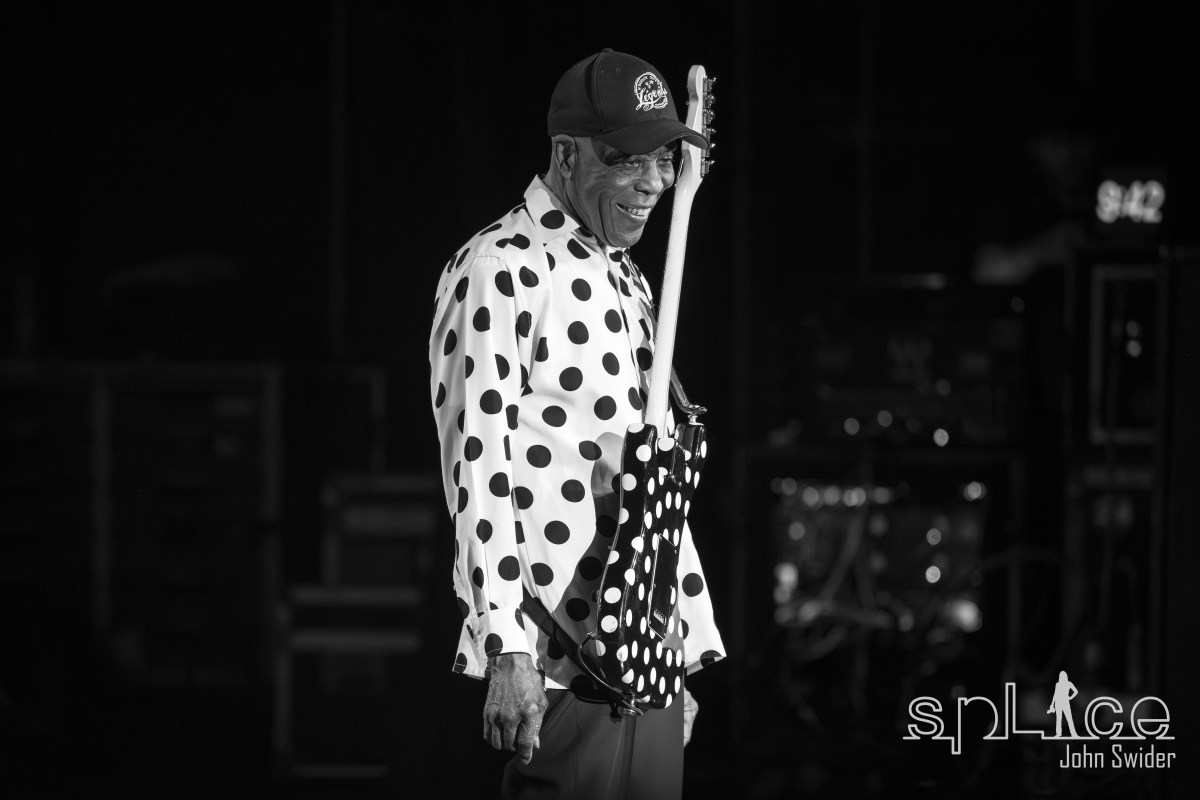
Later, encore stretched into a medley that included “Mad Love (I Want You to Love Me),” and flirted with reprises of earlier tracks like “Hoochie Coochie Man” and “How Blue Can You Get?” When it finally ended, Buddy Guy stood alone under the spotlight, tossing guitar picks into the crowd and flashing that sly, sideways grin. He waved, mouthed “thank you,” and took a long look around as if to imprint it all.
The crowd gave him a standing ovation that felt more like a send-off and a thank-you letter rolled into one.
There’s a moment at every Buddy Guy show—somewhere between the stories, the guitar acrobatics, and the gut-punch vocal lines—where it hits you: this man is the blues. He’s not interpreting or imitating it, he’s lived and survived it, turning it into something transcendent.
July 19th wasn’t just another stop on the road. It was a moment suspended in time. A night when past, present, and future all stood on the same stage. And while the curtain may soon close on Buddy Guy’s touring career, what he gave Saturday night to his fans won’t fade anytime soon.
Because legends don’t retire. They echo…………John Swider