


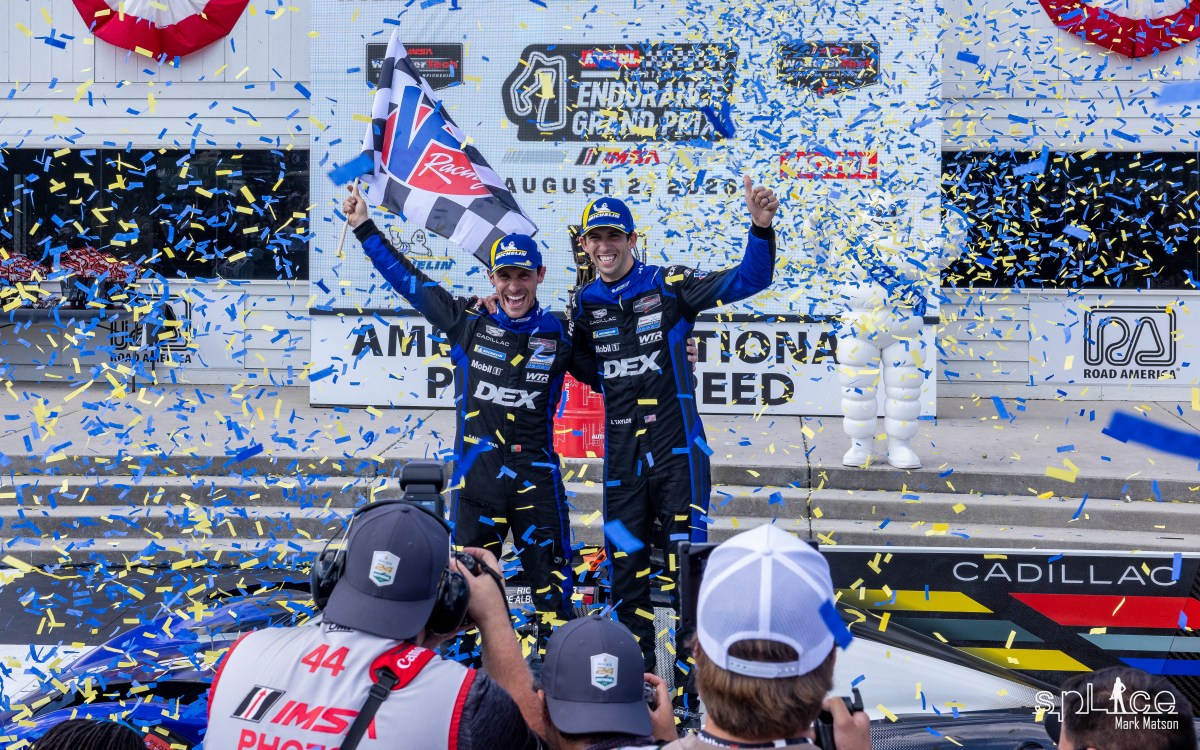
Elkhart Lake, WI (August 2,2026)
For more than a decade, the IMSA Michelin Endurance Cup has served as a championship within the championship, a five-race test of speed, reliability, and execution that separates the contenders from everyone else.
The names are familiar. Daytona. Sebring. Watkins Glen. Indianapolis. Petit Le Mans.
Each event carries its own identity. Daytona is about survival and preparation. Sebring punishes equipment and drivers alike. Watkins Glen rewards consistency and efficiency. Petit Le Mans is a season finale where every mistake is magnified.
For years, Indianapolis held the six-hour slot on the calendar. In 2026, however, IMSA decided to rewrite that chapter.
The endurance race moved north.
Road America, the legendary 4.048-mile circuit nestled among the rolling hills of Elkhart Lake, Wisconsin, became the newest venue to host an IMSA endurance classic. The traditional two-hour, 40-minute sprint race was expanded into a six-hour battle, transforming one of the most popular stops on the WeatherTech SportsCar Championship calendar into a true test of endurance.
The move made immediate sense.
Road America has always possessed the ingredients necessary for a great endurance race. The long straights create opportunities for aggressive overtakes, while the fast corners and dramatic elevation changes leave no room for complacency. Unlike many modern circuits, Road America rewards commitment. Drivers who hesitate lose time. Drivers who overreach find the consequences quickly.


A six-hour race would magnify everything that makes the circuit special.
It would also introduce an entirely new set of challenges.
As teams arrived in Wisconsin, one question dominated conversations throughout the paddock.
What would the weather do?
Forecasts suggested rain could impact nearly every stage of the weekend. Practice sessions, qualifying, and even the race itself carried the possibility of changing conditions.
For teams preparing for their first endurance race at Road America, every wet lap mattered.
When rain arrived during practice, there was no hesitation. Teams took advantage of the conditions rather than waiting for a return to sunshine. Engineers collected data on tire performance, suspension settings, and braking behavior, while drivers learned how the circuit changed when grip levels disappeared.
Those sessions became invaluable preparation for a race where a sudden shower could have changed everything.
By qualifying, however, the weather had shifted. The clouds began to clear, the track dried, and slick tires returned to the cars.
The result was one of the most competitive qualifying sessions of the season.

Qualifying Sets the Stage
The GTD field was the first to take center stage, and Lilou Wadoux continued what has become one of the breakout stories of the 2026 season.
Driving the No. 21 AF Corse Ferrari 296 GT3, the French driver delivered a commanding lap of 2:04.688 to secure pole position. Fresh from her GTD victory at the Twelve Hours of Sebring earlier in the year, Wadoux once again demonstrated why she has quickly become one of the most highly regarded young talents in international sports car racing.
The achievement also carried historical significance.
Wadoux became the first woman to earn an IMSA class pole since Katherine Legge accomplished the feat in 2018.
In GTD PRO, AO Racing’s unmistakable Porsche 911 GT3 R, better known throughout the paddock as “Rexy,” captured another memorable moment.
Harry King put together a standout qualifying performance in the No. 77 Porsche, recording a 2:04.042 lap to claim his first IMSA pole position. The excitement was obvious as King climbed from the car, having delivered one of the biggest qualifying moments of his young IMSA career.
The LMP2 session came down to the final minutes.
With less than five minutes remaining, Daniel Goldburg set the benchmark in the No. 22 United Autosports Oreca LMP2 07 Gibson with a lap of 1:54.212. Despite several late attempts, nobody could match the time, giving Goldburg his first pole position of the season.
But the biggest questions surrounded the premier GTP class.

IMSA’s Balance of Performance adjustments heading into Road America created plenty of discussion. Action Express Racing arrived with momentum following consecutive victories, but the Cadillac V-Series.R received an additional 21 kilograms of minimum weight in an effort to balance competition.
The Acura entries were unchanged.
Would the adjustment reshape the order?
Qualifying suggested it would.
Acura Meyer Shank Racing with Curb Agajanian locked out the front row, with Nick Yelloly placing the No. 93 Acura ARX-06 on pole after a lap of 1:49.233. Teammate Tom Blomqvist followed closely behind in the No. 60 Acura, giving the team the ideal starting position for a six-hour contest.
By Sunday afternoon, the rain that had dominated the forecast had disappeared.
The skies remained threatening, but the storms never arrived. Fans filled the hillsides surrounding one of America’s most iconic circuits as IMSA prepared for a new endurance chapter.
When the green flag fell, Yelloly led the field into Turn 1.
The first six-hour race at Road America was officially underway.
And everyone knew the opening lap would only be the beginning.
The opening laps of an endurance race are always a delicate balance.
Drivers know there are six hours ahead, yet nobody wants to surrender track position. The first stint at Road America was no different. With the GTP field separated by fractions of a second, the opening hours became a chess match played at full speed.

The No. 93 Acura ARX-06 of Meyer Shank Racing controlled the early stages after starting from pole, but the lead was never secure. Behind Yelloly, the GTP field quickly settled into the familiar rhythm of endurance competition: save when possible, attack when necessary, and wait for the moments when strategy could swing the race.
Because at Road America, the fastest car is not always the car that wins.
The six-hour format brought a new layer of complexity to the Wisconsin classic. Pit windows became critical. Tire management became a constant conversation. Every caution carried the potential to either rescue a struggling team or erase an advantage built over multiple stints.
And there were plenty of opportunities for the race to change direction.
Cadillac Finds the Right Formula
Wayne Taylor Racing arrived at Road America searching for a breakthrough.
The organization had spent years establishing itself as one of IMSA’s benchmark teams, collecting championships and major victories with Acura before moving to Cadillac machinery. The transition, however, had not delivered the immediate results many expected.
The speed was there.
The expectations were there.
The victories had not been.
Road America finally changed that.
The No. 10 Cadillac V-Series.R shared by Filipe Albuquerque and Ricky Taylor was not necessarily the dominant car from the start of the afternoon. Instead, it was the car that continued to put itself in position.
That distinction is often what separates endurance winners from everyone else.
While others encountered difficulties, the No. 10 Cadillac remained consistent. Albuquerque and Taylor avoided unnecessary risks, maximized every pit stop, and allowed the race to come to them.
As the afternoon progressed, the battle at the front became increasingly intense. Cadillac, Porsche, and Acura all had moments where they appeared to hold the advantage, but changing strategies and caution periods prevented anyone from controlling the race for long.
With roughly 90 minutes remaining, Albuquerque made the decisive move.
The Portuguese driver brought the No. 10 Cadillac to the front and immediately found himself under pressure from behind. The closing stages became a test of concentration as championship contenders closed in and every corner carried the possibility of disaster.
The No. 6 Porsche Penske Motorsport Porsche 963 of Kevin Estre and the No. 31 Whelen Cadillac of Jack Aitken were fighting for position behind him, with both drivers knowing the outcome would have major championship consequences.
Albuquerque could not afford a mistake.
The Cadillac had the lead, but victory was far from guaranteed.

The Final Caution Changes Everything
Endurance races often come down to a single moment.
At Road America, that moment arrived with less than ten minutes remaining.
Estre and Aitken were battling aggressively for second place when contact between the two contenders changed the entire complexion of the race. The No. 31 Cadillac was sent into the Turn 1 barrier, while the No. 6 Porsche continued into the gravel at Turn 3.
Both drivers were evaluated and released from the infield care center, but the incident brought out the ninth and final full-course caution of the afternoon.
The race would finish under yellow.
For Wayne Taylor Racing, the timing could not have been better.
The No. 10 Cadillac crossed the finish line to claim the team’s first GTP victory since 2024 and its first major breakthrough with Cadillac machinery.
For Albuquerque, the win carried special meaning.
After a season filled with challenges, the veteran driver described the victory as a reward for the team’s persistence and belief.
The victory also represented another milestone for Ricky Taylor, who collected his 33rd IMSA career win and moved into second place among active drivers.
But beyond statistics, the victory represented something more important.
Confidence.
Wayne Taylor Racing had not forgotten how to win.
Road America proved it.
Porsche Keeps the Championship Battle Alive
While Cadillac celebrated at the front, the championship fight behind them underwent a dramatic shift.
The No. 5 JDC-Miller Motorsports Porsche 963 of Laurin Heinrich, Tijmen van der Helm, and Kaylen Frederick delivered a crucial second-place finish, turning a challenging weekend into a championship opportunity.
Heinrich entered Road America facing a significant deficit to Jack Aitken in the standings. After Aitken’s late-race incident, the gap tightened dramatically.
Suddenly, a championship that appeared to be slipping away became a legitimate battle again.
That is the nature of endurance racing.
Momentum can change in seconds.
With only two races remaining, Heinrich’s championship hopes remained alive, though the margin was still substantial.
For Aitken, the focus shifted from defending a comfortable advantage to managing the final stretch of the season.

Inter Europol Controls a Chaotic LMP2 Fight
The LMP2 class produced its own endurance thriller.
The No. 43 Inter Europol Competition Oreca LMP2 07 of Jeremy Clarke, Tom Dillmann, and Bijoy Garg emerged as the class winner after a performance built on patience and execution.
The team controlled much of the race, leading 83 laps, but the victory was anything but simple.
LMP2 competition has always been defined by close racing and aggressive strategy, and Road America delivered exactly that. The frequent caution periods repeatedly changed the complexion of the class battle, forcing teams to adjust fuel calculations and restart plans.
Inter Europol avoided the mistakes that affected others.
The team remained composed through the chaos and positioned itself perfectly for the decisive late-race restart.
When the opportunity arrived, Dillmann made it count.
The final restart featured a three-wide battle for the lead, but Inter Europol emerged ahead and never surrendered control.
The victory was the team’s second of the season and tightened the championship fight considerably. Clarke and Dillmann reduced the gap to championship leaders George Kurtz and Alex Quinn to 36 points with two races remaining.
CrowdStrike Racing by APR finished second, while TDS Racing celebrated its first podium of the season in third.
Pfaff Motorsports Creates Lamborghini History
If the GTP victory belonged to perseverance, GTD PRO belonged to history.
Pfaff Motorsports delivered one of the most significant victories of the weekend by securing the first IMSA WeatherTech SportsCar Championship win for Lamborghini’s new Temerario GT3.
The No. 9 Lamborghini shared by Andrea Caldarelli and Sandy Mitchell completed a near-perfect six-hour performance, combining speed, reliability, and strategic execution.
For Pfaff, the victory carried deep meaning.
The Canadian organization had been heavily involved in the development of Lamborghini’s newest GT3 project. After years of success with Porsche, including championships in GTD and GTD PRO, Pfaff had endured a difficult stretch while adapting to a new manufacturer partnership.
The team’s last IMSA victory had come in 2023.
Road America ended the drought.
A revised brake package introduced for the event helped provide drivers with greater confidence, but the victory was about more than a single technical improvement. It was the result of months of development and persistence.
Caldarelli, who has spent nearly a decade representing Lamborghini, understood the significance.
The Temerario project had progressed dramatically in only a year, transforming from a new concept into an IMSA race winner.
Mitchell also earned his first WeatherTech Championship victory, crediting the team’s strategy calls and the car’s consistency throughout the afternoon.
AO Racing’s Porsche 911 GT3 R finished second after starting from pole, with Nick Tandy and Harry King continuing their strong season. Corvette Racing by Pratt Miller Motorsports completed the podium with Tommy Milner and Nicky Catsburg in the Corvette Z06 GT3.R.
The championship picture tightened as well. Paul Miller Racing’s BMW duo of Neil Verhagen and Connor De Phillippi maintained the points lead, but their advantage was reduced heading into the final races.

Winward Racing Returns to Victory Lane in GTD
The GTD class produced another important championship result.
Winward Racing returned to the top step with the No. 57 Mercedes-AMG GT3 of Russell Ward and Philip Ellis, joined by Indy Dontje for the endurance event.
The victory marked the team’s third win of the 2026 season and reignited its pursuit of a third consecutive championship.
Unlike some races decided by outright pace, Road America rewarded patience.
Winward approached the event as an endurance race, focusing on fuel management and positioning itself for the final stages. When opportunities appeared, the team was ready.
The result moved Ward and Ellis closer to championship leader Eduardo Barrichello, whose difficult afternoon tightened the standings.
Triarsi Competizione finished second with its Ferrari 296 GT3 EVO after a strategic gamble paid off during the closing caution periods.
CarBahn completed the podium with its Aston Martin Vantage GT3 EVO, earning its second podium finish in only its second GTD appearance.
A New Endurance Classic Is Born
The first six-hour race at Road America had a simple objective: prove that one of America’s greatest road courses could host an endurance classic.
It succeeded.
The inaugural Motul SportsCar Endurance Grand Prix delivered everything IMSA fans expect from a long-distance race. There were strategic battles, championship drama, emotional victories, and a finish that remained uncertain until the final moments.
Wayne Taylor Racing found redemption.
Inter Europol strengthened its championship position.
Pfaff Motorsports created Lamborghini history.
Winward Racing revived its title hopes.
Road America did more than host an endurance race.
It earned its place among them.
The Michelin Endurance Cup is built around events that test every element of a team. Speed matters, but preparation, patience, and execution ultimately decide who survives.
At America’s National Park of Speed, IMSA discovered a venue ready for that challenge.
IMSA:



Road America: